MASTER MARKETING FOODSERVICE
What Problems Does the New Website Solve?
Master Marketing’s old site told visitors who the company was. It didn’t do anything for them once they arrived: no way to find which manufacturers served their state, no way to see the territory at a glance, and no path from “browsing” to “booking a call.”
A few problems stood out early:
- No searchable manufacturer directory. Dozens of manufacturer lines existed only as a static list, with no way to filter by region, state, or equipment type.
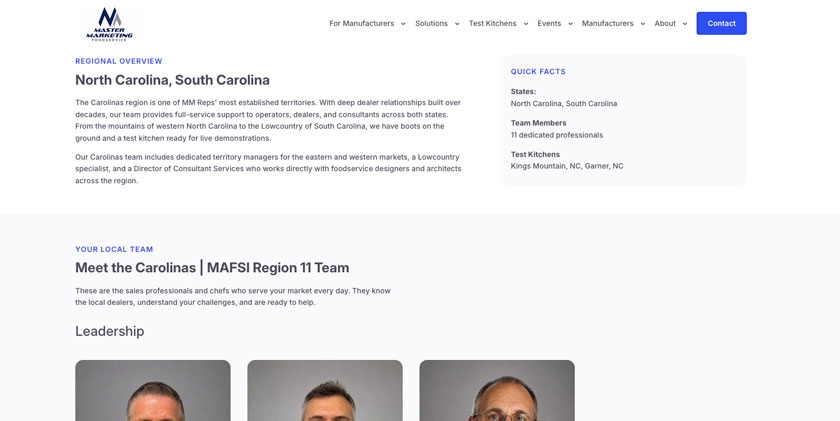
- No visual sense of territory. Master Marketing covers a large, irregular footprint across the Southeast, organized by MAFSI region rather than simple state lines. There was no way for a dealer or manufacturer to see that at a glance.
- Events lived nowhere. Demos, showcases, and trade show appearances had no central home, no registration flow, and no way to filter by region.
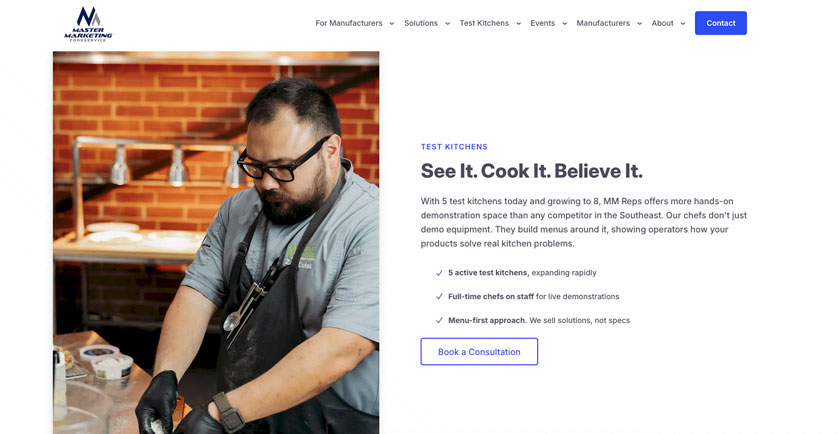
- Test kitchens were invisible. Five active locations (with more opening) had no dedicated presence to drive visits or bookings.
- The site wasn’t built to rank. In a market where direct competitors have close to no organic search presence, a well-structured site was a genuine competitive opening rather than table stakes.
Project Goals
Master Marketing is a broker-based rep firm. It doesn’t manufacture or catalog its own products; every line it represents keeps its own catalog. That distinction shaped the entire information architecture: the site’s job was to organize other people’s products around Master Marketing’s territory and relationships, not to act as a storefront.
Getting the regional structure right took a real discovery conversation. Master Marketing’s coverage isn’t just “which states,” it’s MAFSI region alignment layered on top of state and sub-state boundaries (Florida Panhandle, West Tennessee, and Tennessee Mid/East all carry different manufacturer rosters than their parent states). Locking that structure down early, along with confirming that Sunlow (the company’s separate wholesale distribution arm) would stay out of this build’s scope, kept the project aimed at the right target instead of guessing at it.
Project goals:
- Turn the manufacturer list into a searchable directory, filterable by region, state, and brand, with an indexed landing page per manufacturer
- Give the territory a visual, interactive home instead of a text description
- Build a real events system: upcoming and past events, region filtering, registration, and automatic archiving
- Give the five (soon eight) test kitchen locations dedicated pages that support local search and drive bookings
- Write every page to answer a buyer’s or dealer’s actual question and point them toward a form
Site Design
System Build
Tech Stack
- WordPress
- Divi 5 (page builder / child theme)
- Advanced Custom Fields (ACF)
- The Events Calendar + Event Tickets
- Google Maps JS API (self-hosted GeoJSON for territory boundaries)
- PHP / JavaScript
- Kinsta (hosting) behind Cloudflare
Project Management Systems
Asana – Client communication
Harvest – Time tracking
Slack – Internal Communication
Website Features
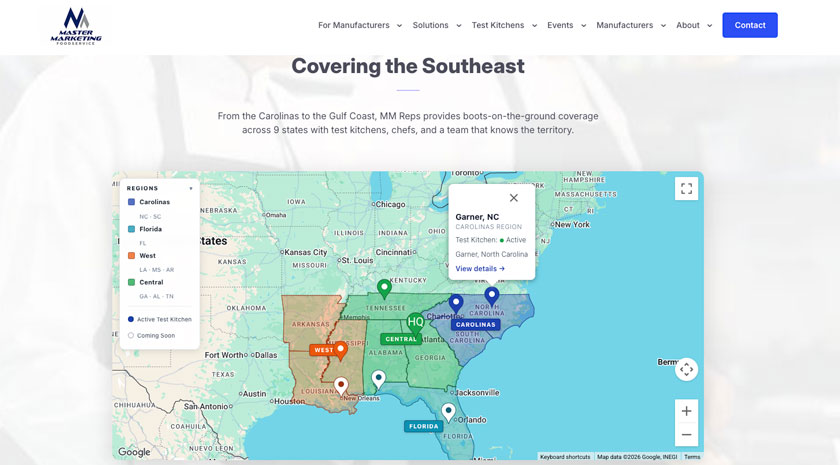
#1 Interactive territory map A live map of Master Marketing’s coverage area, built on the Google Maps JS API with self-hosted, simplified GeoJSON boundaries. It marks active test kitchens against locations still coming online, and reflects the same MAFSI-region and state data that powers the manufacturer directory, so the map, the directory, and the region pages never drift out of sync.
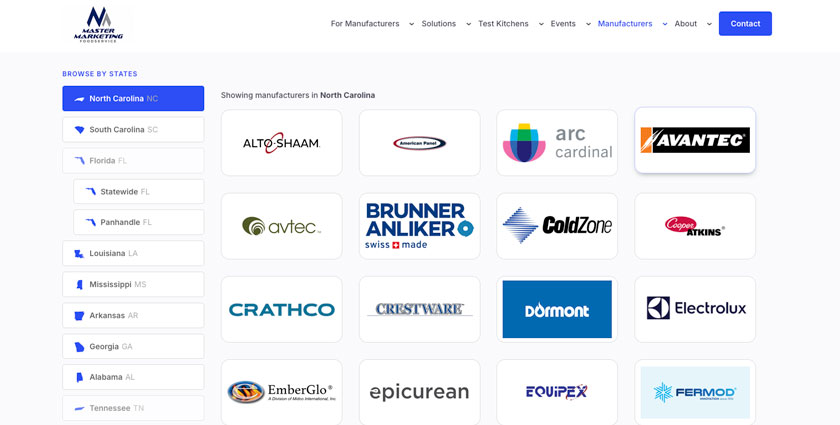
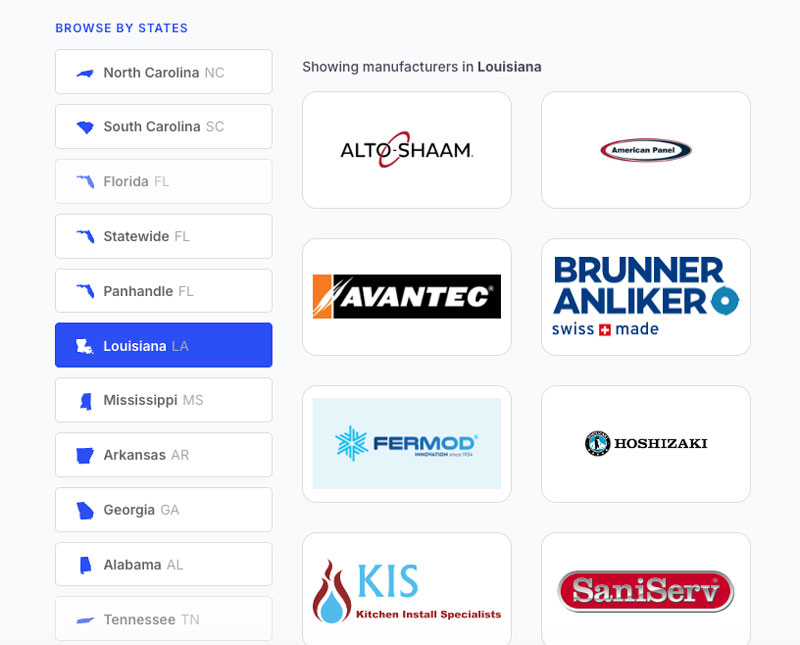
#2 Searchable, filterable manufacturer directory Dozens of manufacturer lines, filterable by region, state, and sub-region, each with its own indexed landing page. A dealer in the Florida Panhandle sees a different roster than one in the Carolinas, pulled automatically from the same underlying taxonomy rather than a manually maintained page per region.
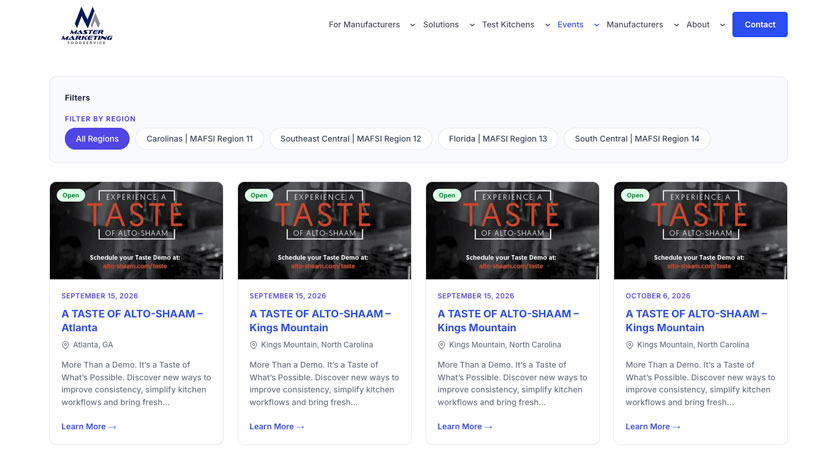
#3 Events system with region filtering and auto-archiving Upcoming and past events pull from the same custom filter shortcode, splitting automatically by date and filterable by MAFSI region. Registration and capacity are handled through The Events Calendar and Event Tickets, with past events archiving on their own instead of needing manual cleanup.
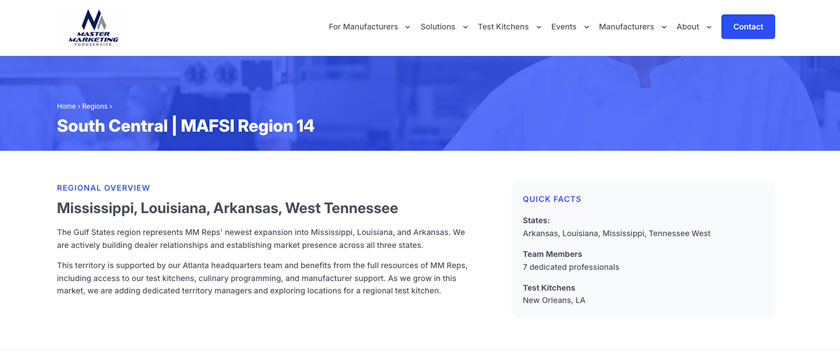
#4 Region pages with dynamic team and manufacturer grouping Each region page pulls its own team roster (with per-region department overrides where a person’s role differs by territory) and its own manufacturer grid, generated from the same shared taxonomy data that drives the map and directory.
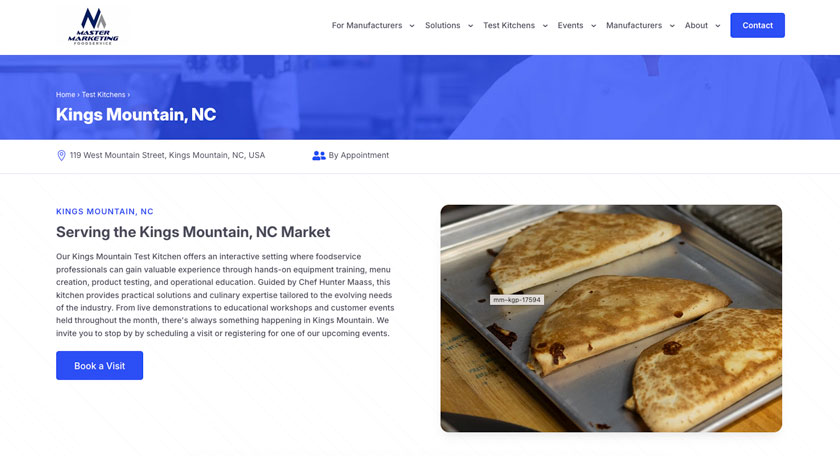
#5 Test kitchen location pages Five active kitchens today, with pages for locations still coming online flagged automatically as “opening soon” rather than needing a manual toggle, based on each kitchen’s status and opening year.
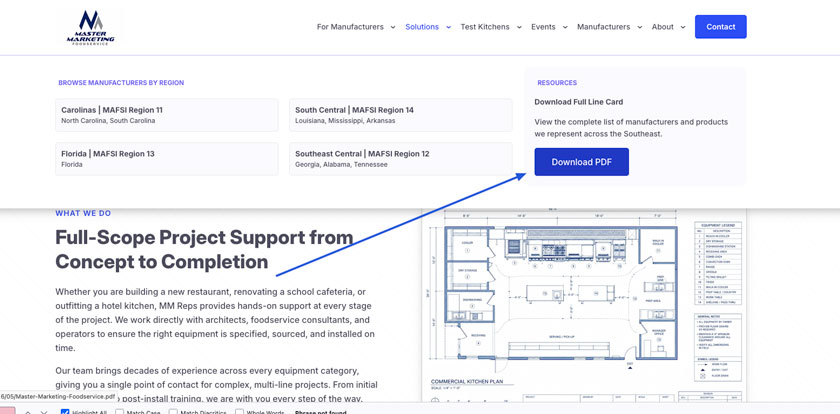
#6 Downloadable line card and gated resources A full manufacturer line card is available as an instant PDF download, giving dealers and operators a leave-behind resource without needing a form.